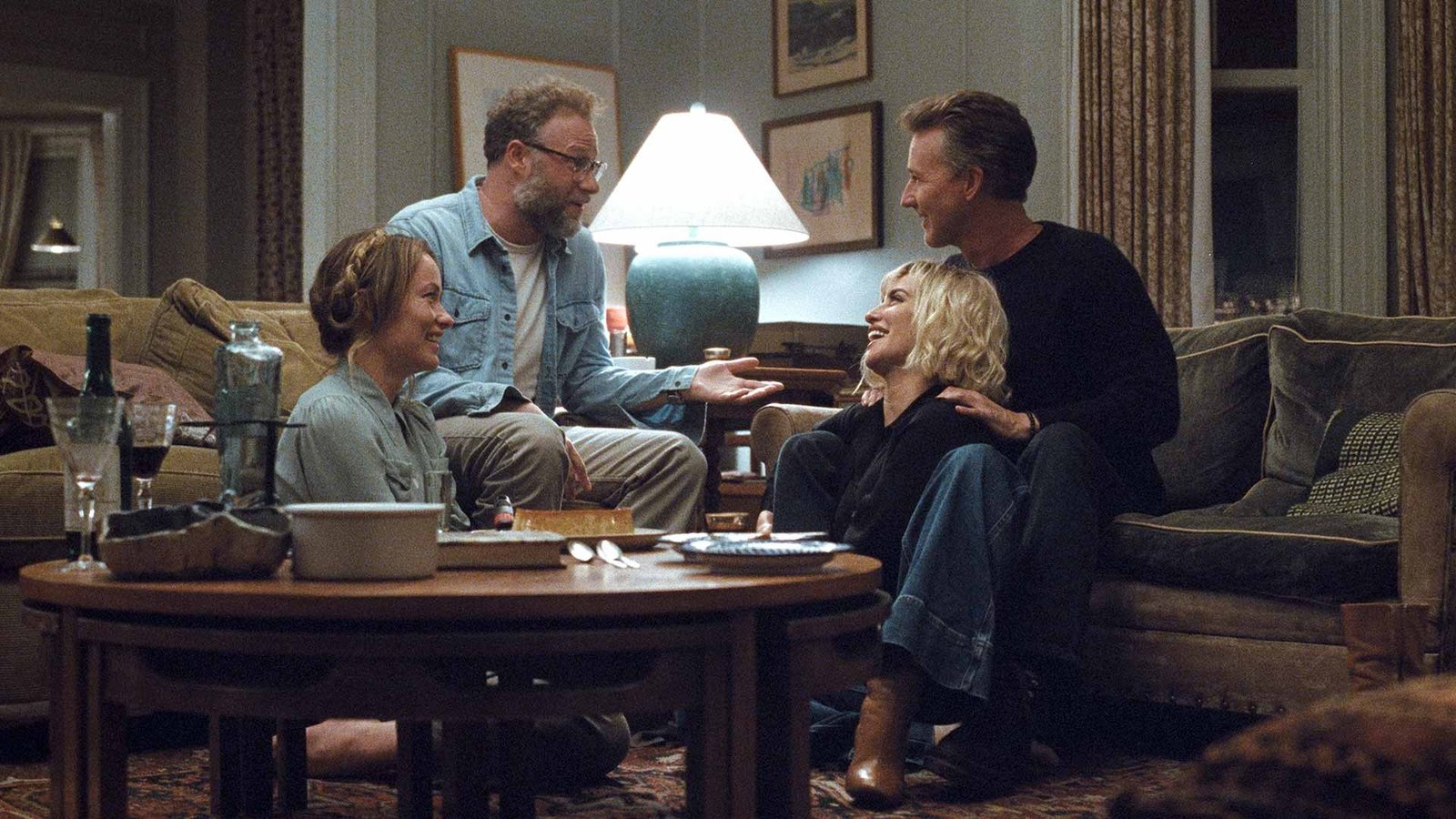
An intimate exploration of relationships, desire, emotional disconnection and the uncomfortable truths we hide behind the walls of our homes.
Spoiler Warning: This review discusses important story developments and the ending.
An Invitation That Uncovers More Than Expected
Some films need elaborate storylines to explore human relationships. Others simply place a handful of people in a room and let human nature do the storytelling. Olivia Wilde’s The Invite belongs to the latter.
Joe (Seth Rogen) and Angela (Olivia Wilde) are a married couple whose relationship has gradually deteriorated. When they invite their upstairs neighbours, Piña (Penélope Cruz) and Hawk (Edward Norton), for dinner, an ordinary social gathering turns into an uncomfortable examination of marriage, intimacy and personal identity.
The two couples represent contrasting lifestyles: one trapped in domestic routines, the other embracing a more unconventional relationship. But the dinner party is never really about the guests. It becomes a mirror reflecting everything Joe and Angela have been avoiding.
Two Couples, Two Different Ideas of Happiness
Joe and Angela’s marriage hasn’t collapsed through a dramatic betrayal. Instead, it has slowly lost its emotional connection through unspoken frustrations, predictable arguments and abandoned ambitions.
Piña and Hawk initially appear to have everything their hosts lack: confidence, spontaneity and freedom. Their unconventional relationship challenges Joe and Angela’s assumptions about intimacy and commitment.
But the film wisely avoids presenting either couple as a perfect example of how relationships should work.
Traditional marriage doesn’t automatically guarantee happiness, just as unconventional relationships don’t automatically create fulfilment.
The film raises a more interesting question: Are we genuinely attracted to a different way of living, or are we simply dissatisfied with our own?
The Dinner Table as a Psychological Battlefield
One of the film’s strongest decisions is its confined setting. Almost the entire story unfolds inside Joe and Angela’s apartment, where an ordinary dinner gradually transforms into a psychological battlefield.
Innocent questions become accusations, jokes expose insecurities, and casual conversations reveal years of emotional neglect.
The screenplay by Rashida Jones and Will McCormack understands that relationships are often defined by what people struggle to say rather than what they actually communicate.
The humour emerges naturally from this discomfort. We laugh at the awkwardness, sometimes recognising just how familiar these situations feel.
Desire, Identity and Emotional Disconnection
Beyond its provocative premise, The Invite explores the difference between physical desire and genuine intimacy.
Joe and Angela’s curiosity about their neighbours’ lifestyle reflects something missing from their marriage: excitement. But their attraction to something new is complicated by insecurity and the desire to feel wanted again.
Angela’s dissatisfaction goes deeper than her relationship. She has gradually lost touch with her individuality and artistic ambitions, becoming increasingly defined by her domestic responsibilities.
Joe, meanwhile, carries the disappointment of unfulfilled musical ambitions. His sarcasm and defensiveness conceal a man disconnected from the person he once wanted to become.
The piano becomes an important symbol of this neglected identity.
Both characters are searching for something they have lost, but their journeys are different. The film suggests that sometimes people must rediscover themselves before they can understand what they truly want from a relationship.
Cinematography and Performances
Adam Newport-Berra’s cinematography complements the film’s psychological themes through mirrors, reflections and enclosed compositions. The apartment becomes an extension of its inhabitants: people sharing the same physical space while remaining emotionally distant.
The confined environment also makes the growing tension feel increasingly claustrophobic.
The performances give the film its emotional foundation. Seth Rogen balances familiar comic timing with genuine vulnerability, while Olivia Wilde brings complexity to Angela’s gradual emotional awakening.
Penélope Cruz is captivating as the confident yet unpredictable Piña, and Edward Norton gives Hawk an eccentric charm that prevents him from becoming a simple caricature.
Together, the four actors create a dynamic in which nobody is entirely right or entirely wrong.
The Ending: Reconciliation or a New Beginning?
Spoilers ahead.
After an evening of uncomfortable revelations, Joe and Angela acknowledge that their marriage has deteriorated. Their decision to remain together is closely connected to their daughter, raising the difficult question of whether staying in an unhappy relationship is necessarily the right choice.
Piña challenges this assumption, suggesting that children may be better served by genuinely happy parents living separately.
Joe and Angela appear to accept that separation might be necessary.
But after the neighbours leave, Joe returns to his piano and begins playing. Angela eventually joins him, sharing a quiet moment of connection.
Is this reconciliation, or simply a reminder that something meaningful still exists between them?
The film deliberately avoids an answer.
The piano becomes a metaphor for communication. After spending the evening struggling to understand one another through words, Joe and Angela reconnect through music.
Yet sharing a beautiful moment doesn’t necessarily mean they are ready to share the same future.
That ambiguity makes the ending particularly effective. It offers hope without promising a convenient resolution.
What The Invite Ultimately Says About Relationships
Beneath its humour, The Invite is about the identities people gradually lose within relationships.
We enter relationships with individual ambitions, insecurities and expectations. Over time, some parts of us change, while others quietly disappear.
The film reminds us that love alone cannot guarantee a fulfilling relationship. People must continue understanding one another as individuals, even after years of sharing a life.
Sometimes, the biggest obstacle isn’t the absence of love. It’s the inability to recognise who the people involved have become.
Final Thoughts: An Uncomfortable Evening Worth Experiencing
The Invite doesn’t rely on a complicated plot or spectacular cinematic moments. Its appeal lies in watching four adults confront the uncomfortable truths behind their seemingly different lifestyles.
Olivia Wilde delivers an engaging character-driven film supported by a strong ensemble. Although its deliberate pacing and extended conversations may not appeal to everyone, its strongest moments offer genuine emotional depth.
The film doesn’t tell us that every marriage should be saved or that separation is always the answer. Instead, it encourages us to question what happiness, intimacy and commitment really mean.
There are only two kinds of movies: the ones you like and the ones you don’t. But every once in a while, a film gives you something worth discussing long after the screen goes dark.
The Invite is one of those films.